September 2026

Finding the Reset: A Wyoming Bighorn Sheep and Mule Deer Season
Hunter: Bev Hawkins
Species: Rocky Mountain Bighorn Sheep and Mule Deer
Location: Wyoming, near Dubois
Method: Rifle (.300 PRC), self-guided
There is something honest about suffering. It strips everything else away. And when the sun finally slips out from behind the clouds and warms your face for a few brief seconds, it feels earned. I don’t know when it happened, or exactly how, but somewhere between the blisters and burning feet, the sweat soaking my back, and the restless nights without a pillow, I found myself.
Looking for a Reset
My story starts in the raw whirlwind of everyday life—work, cooking dinner, shuttling the boys to practice, and squeezing homework into whatever cracks remained. Somewhere in that blur, I vaguely remember a short conversation with my husband, Jake. He asked which hunts I wanted to put in for that year. I’m fairly certain I waved him off and said something like, “Just put me in for the hard-to-draw stuff. It’ll be really inconvenient to draw anything this year.” And then, like so many things in that season of life, the conversation disappeared into the noise.
By late spring, I found myself in what could best be described as a low-grade midlife crisis. Not a dramatic unraveling—more of an itch, a quiet restlessness, a sense that something was missing. A few years earlier, Jake and I had sold a business and moved to Dubois—a town of fewer than 900 people— at my urging. Almost immediately after arriving, I decided to go back to school and become a teacher while Jake began building a house. At the time, it felt like exactly the right decision. Three years later, I wasn’t so sure. I’d wanted a reset. I just didn’t know how to stop everything long enough to actually find one.
Drawing a Sheep Tag and a Deer Rut Tag
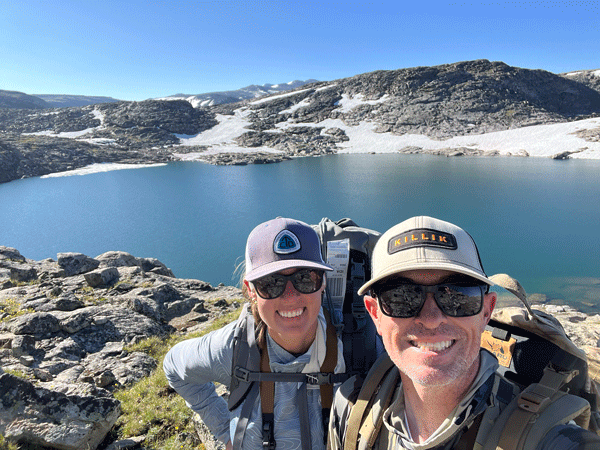
On May 8, Jake sent me a text: I had successfully drawn a sheep tag. Tears filled my eyes. I knew instantly this was the adventure I’d been searching for. My objectives were simple: an adventure and a sheep head—whether it came from a ram I shot or a deadhead I found. I just wanted a sheep head. During the spring, I logged good miles shed hunting, but lingering snow meant scouting season was still a long way off.
In June, we took a family trip to Belize. One evening, sitting by the pool, Jake opened his email and announced that I was officially the luckiest person alive: I had also drawn a highly sought-after deer rut tag.
Scouting Above 10,000 Feet
By July, the snow had finally receded enough for us to hit the ground running. Unless it’s shed season, I hike in trail shoes, so I bought a brand-new pair of Hoka Speedgoats and went to work. We loaded our packs and spent portions of nearly every weekend in the field—hopping boulders and climbing sheep trails that most people would never consider hiking.
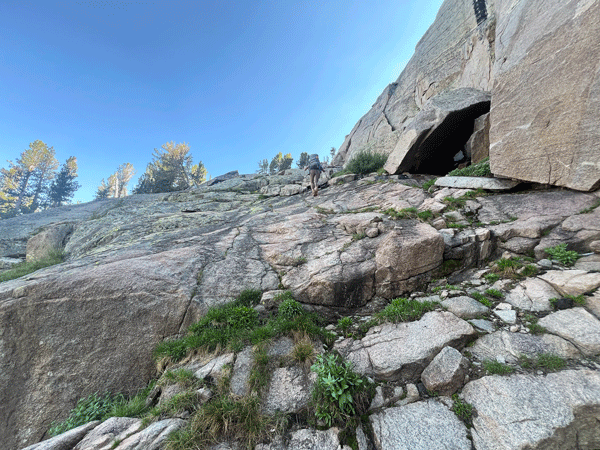
Hunting sheep above 10,000 feet is its own kind of adventure. One moment you’re rolling up your sleeves and applying sunscreen; the next you’re huddled under a shelter in a puffer coat and rain gear, waiting out a sleet storm. One day, Jake slipped and got wedged between two slick boulders. Another day, a rock shifted and smashed my foot. More than once, we were amazed our tent poles survived the night as the wind flattened the tent over us while we lay inside.
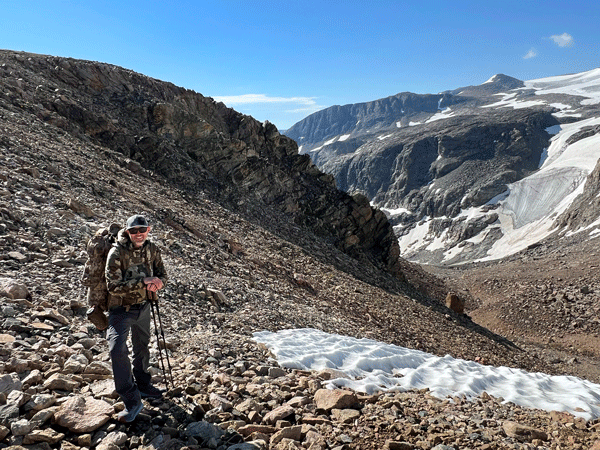
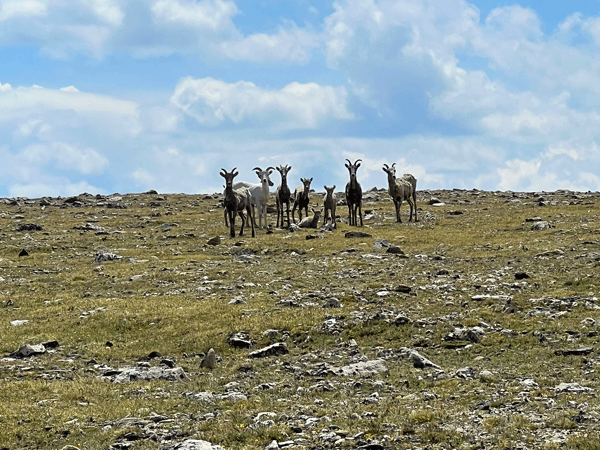
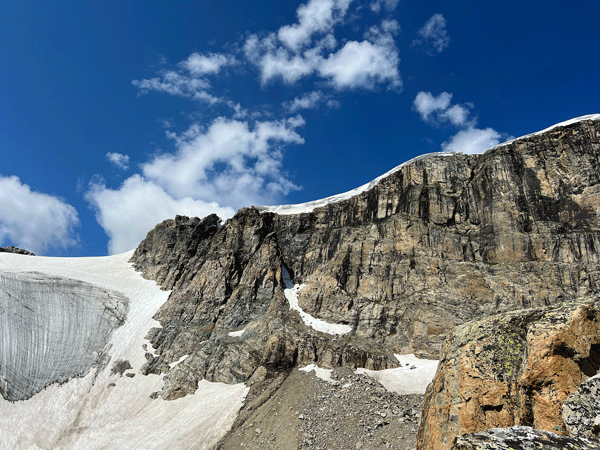
By the end of July, my Hokas were retired—I don’t think they made it seventy-five miles. Up on top of the world, we bumped into a bunch of little sheep with one small ram as white as a Dall sheep. We’d seen glaciers and stunning alpine lakes. What we hadn’t seen was a ram big enough to shoot.
Waiting for the Right Ram
August arrived, and the hunt opened to archery season. There were four other hunters. One filled his tag in the first few days. When rifle season opened on August 15, the others followed, one by one. Each ram taken was impressive, and I started to wonder what we were doing wrong. Still, I knew I needed to keep looking. I didn’t feel pressured yet—I had until October—and I was grateful to finally have the mountain to myself.
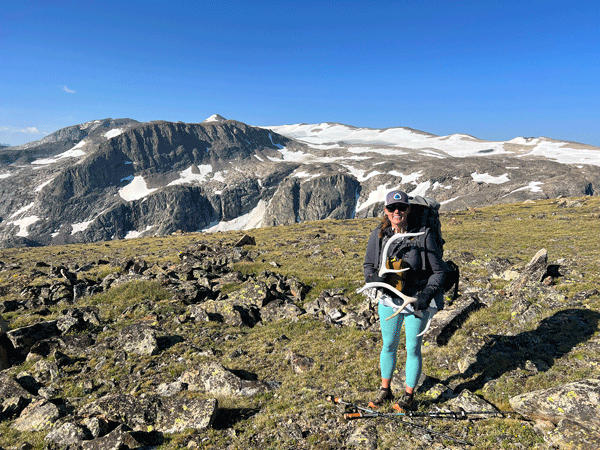
Over Labor Day weekend, Jake went in early to set up camp and scout while I came in later. On Friday, he found a deadhead, which I promptly and proudly claimed. The grass was dry and dead, and what sheep we did spot were on green grass. We decided to try a new area on the other side of the mountain. If we got lucky and found sheep, Jake warned, we’d be sleeping on the mountain without tents or sleeping bags.
I wasn’t thrilled—but I wanted a sheep.
On our way in, we stopped to rest and glass. Almost immediately, Jake spotted two sheep and told me we needed to back out of their line of sight. We eased around a small rise and watched. One wasn’t a shooter. The other looked borderline, depending on how the light hit his horns.
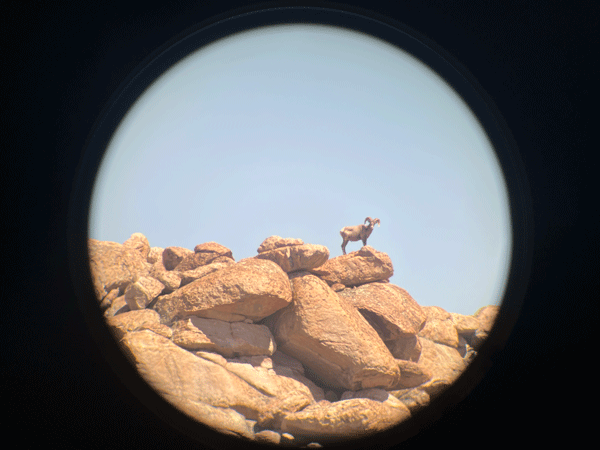
Jake kept asking what I thought. I told him the truth: I had no idea. I’d never shot a ram. He admitted he hadn’t either and reminded me that this was my tag. We decided to watch longer. I would rather walk away empty-handed than carry out a ram I wasn’t proud of. By then, my cup was already overflowing with adventure, and I had accomplished the feat of finding a deadhead, even if I had stolen the find from Jake. Since I couldn’t decide, Jake suggested we at least get within shooting range. We were about 800 yards out—well within the 300 PRC’s capability—but I had only practiced to what I considered an ethical range for me, which was 600 yards.
We backed farther out of sight and began the slow process of crawl, glass, and crawl again until we were inside 600 yards. Up close, the ram looked better. I decided to take the shot. After shifting packs and restacking gear, I finally settled in.
One Shot at Under 600 Yards
When the ram stood and began to walk, disappearing in and out of the rocks, I told myself to stay calm. I held my breath and pulled the trigger.
He ran over the hill. The smaller ram stood on the skyline, staring toward the place where the bigger ram had disappeared. We took it as a good sign.
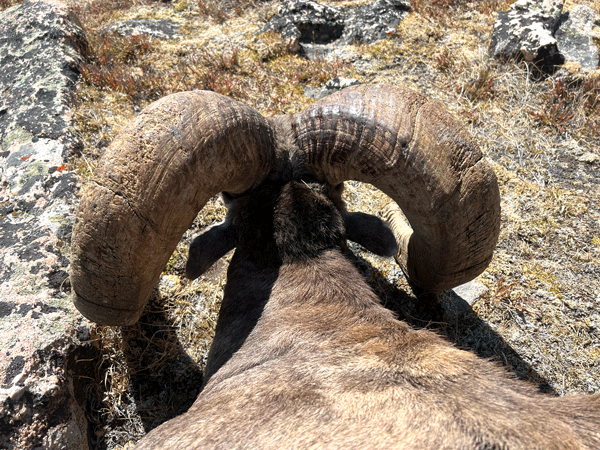
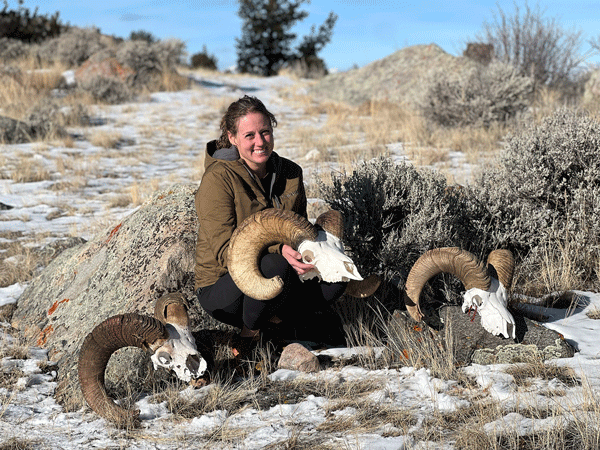
It took time to boulder hop and carefully pick our way up to where we had last seen him. When I saw him, just yards from where he’d been shot, I cried. I cried because I was happy. I cried because he was so majestic. And I cried because this hunt had been the best worst time of my life.
The Long Way Down and a Second Deadhead
With the sheep on our backs, we started the long boulder hop off the mountain. There was a fast way down and a longer, more reasonable route that required less climbing and fewer boulders. We chose the long way.
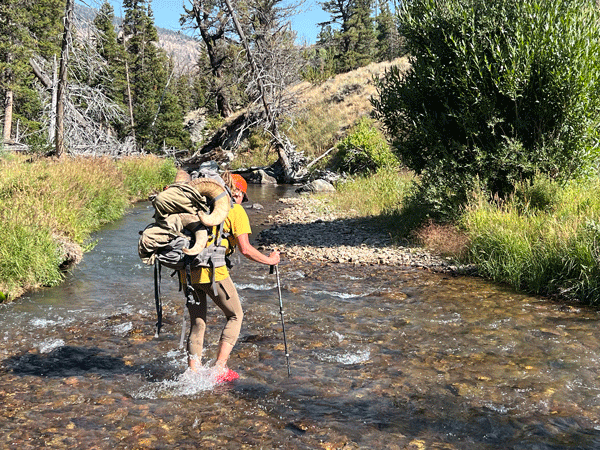
Partway down, Jake suddenly stopped and said, “You aren’t going to believe this—I found another deadhead.” He wanted to mark the spot and leave it. I refused to move until he strapped that sheep head onto my pack. If you’ve never smelled a sheep deadhead, be thankful. Jake assured me this was the surest way to get eaten by a bear.
A Rut Hunt That Felt Like Cheating
I jumped straight back into school and waited for the next season. By October, Jake had injured his shoulder working on our house and was struggling to carry a pack. Because of that, we didn’t get many opportunities to elk hunt together. Elk burger is my favorite meat, so with meat in mind, I went out one evening after school and shot a small five point. The next day, Jake and our son, Zander, packed it out for me. My deer hunt opened in early November. The rut hunt was everything a sheep hunt is not—long cruises in comfortable vehicles, glassing lots of bucks, bringing plenty of drinks and snacks, and never worrying about the weight of licorice in my pack. After the sheep hunt, it honestly felt like cheating—and I was completely okay with that.
This hunt was easier, but enjoyable in a very different way. We rode around in the side-by-side or the truck, only hopping out for short hikes. Our packs were light, and the days were calm and beautiful. We saw a lot of deer, but the rut never seemed to fully kick in. We passed countless bucks in the 160 to 170 range, but I was holding out for something closer to 180. Near the end of the hunt, we decided to check a new area and moved to a high point to glass. From there, we spotted the best deer of the entire hunt.
A One-Antlered Buck at 550 Yards
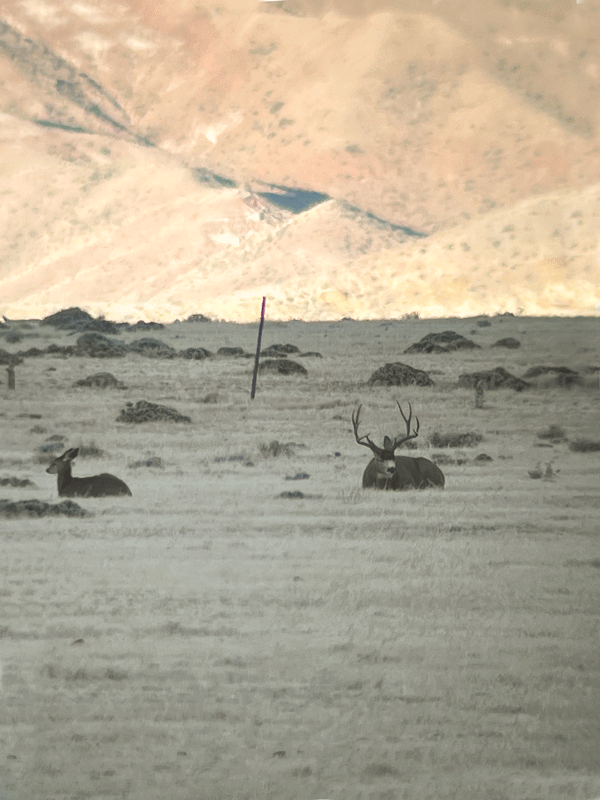
We grabbed our packs and headed his way. He stood in a wide-open meadow, so we stayed in the shade, keeping the trees behind us as the sun dropped lower. We crept along the shadow line until we were within shooting range.
At 550 yards, we set our packs up as a rest. I took a deep breath, held it, and squeezed the trigger. I relocated him immediately in the scope—but I didn’t need a second shot. He dropped instantly.
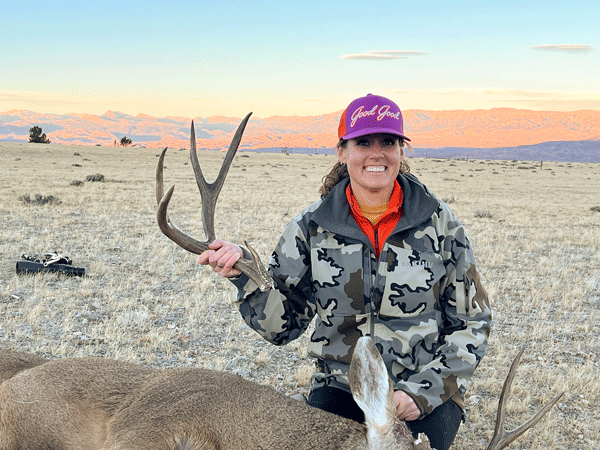
As we walked up and got closer, we realized my deer had only one antler. The other lay on the ground beside him. At first, we thought that he had dropped so hard that he broke his antler, but as we got closer, we realized that I had shot the antler off. The force of the impact must have knocked him out. I took another shot. What an incredible way to end a fantastic season.
The one-antlered deer fell just short of 180, leaving the chapter open for a backcountry deer hunt in 2026…right after we get the rifle sighted back in.
Additional Resources
- Wyoming Application Strategy
- Wyoming State Profile
- Wyoming Hunting Regulations
- Huntin' Fool Adventures
- Become a Huntin' Fool Member