May 2026
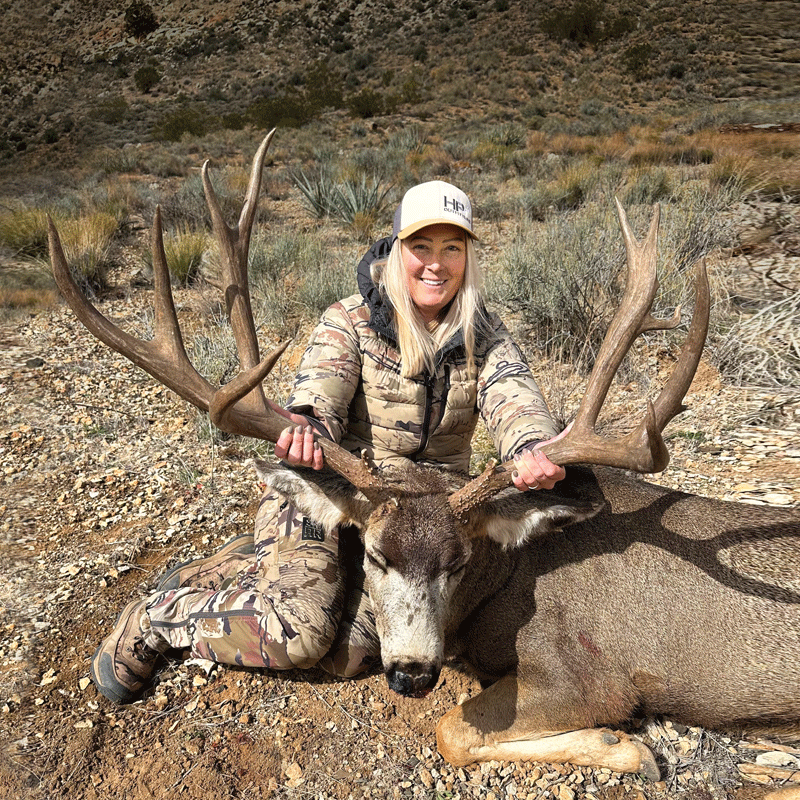
Stubbornly Patient | Arizona Mule Deer
Story By: Rebekah Adams
“Hey, babe, you want to put in for the Kaibab this year?”
Same question, every year.
“Nope,” I’d say. “Thanks for asking, though.”
The Arizona Strip isn’t just a hunt—it’s a commitment. The kind that takes decades. Twenty years to draw a tag, if you’re lucky. Twenty years of preference points, dreaming, waiting. You don’t just wake up and decide to hunt the Strip. You earn it.
When I finally drew tag number five, my husband called me stubborn. Even though he may consider me stubborn, I consider myself extremely patient. Perspective, am I right? That’s what you need when hunting the Arizona Strip: patience or stubbornness. They are probably interchangeable.
The Arizona Strip will chew you up and spit you out. It wears you down until quitting feels like relief. But just when you’re ready to give in, something keeps you going—a quiet, persistent thought that somewhere, just over the next rise, there’s a big buck worth every ounce of effort. It’s addictive in the worst and best way.
Days can pass without seeing a single deer. Not a buck. Not a doe. Nothing. The roads are brutal—dust so thick you can’t see five feet ahead. Then it rains, and that dust turns to mud the consistency of peanut butter. It clings to your tires, packs into wheel wells, pulls at your rig like it wants to drag you off the sheer cliffs. And sometimes, it feels like it might.
But then the sun sets.
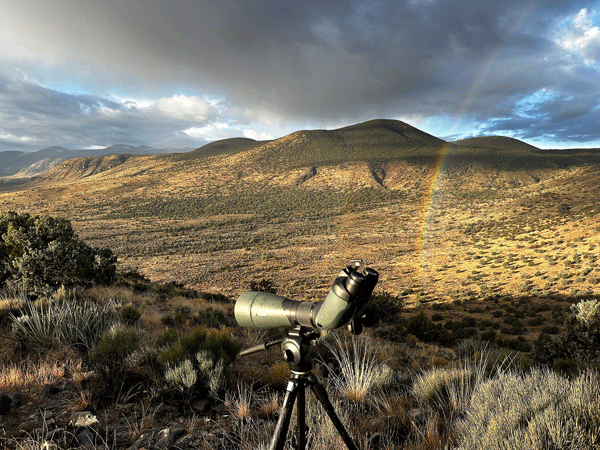
And suddenly, it’s all worth it. The sky explodes in color, the landscape looks almost unreal, and you forget how hard the hunting is… Until the next morning.
We chased whispers of a deer. “There’s a big one in this area,” friends said. It was a massive area with fifteen hunters looking. Only five of those hunters were on our side, but no one had seen him yet this season.
On hunts like these, the pressure builds in a way that’s hard to explain—part competition, part obsession. Who’s better? Who’s luckier? Who’s willing to outlast the others?
Our extra help was only able to stay through the weekend. Just like that, it was the two of us alone in a unit so vast it felt empty. Now we were outnumbered in our search for the “ghost” buck. Days went by without seeing even a deer. Silence stretched in every direction.
Finally, a flicker of life—deer. A small group. Enough to remind us why we were there. Enough to keep us going.
We passed smaller bucks, the kind most hunters would gladly take in another unit. I’d glass them, even settle into my scope for a moment. But this was the Arizona Strip, where giants roam.
“Want to shoot that one?” my husband would ask.
“Nope.” I’d waited too long for this tag.
Stubborn. Patient.
Same thing.
We explored deeper into the unit, chasing terrain as much as deer. Pine-covered ridges full of smaller bucks offered brief moments of relief. Then there were the edges—the kind that make your heart race for all the wrong reasons. Sheer drop-offs, muddy tracks, and one stretch we called “the death edge” where I was certain the mountain was trying to kill me.
Beyond it all, the landscape was surreal. Cinder hills rolled out like something from another world. Broken rock, aspen meadows, cedar flats, oaks, steep climbs, places so remote it felt like no one had ever been there—or ever would again. In those places, slight fear takes over because you know that if something happened it would take help a long time to arrive.
We were trying to cover the whole unit, crossing spots off the map, but we’d always come to another amazing place where deer lived. Another place where we’d tell ourselves we wouldn’t be coming back—despite the beauty—because it was trying its best to kill us.
And that’s where we saw him.
The buck.
The one. This one was not a “ghost.”
He was with his does, and when he caught movement, he vanished in seconds—powerful, fast, untouchable.
On the way back to camp, more good bucks appeared. Big ones. Tempting ones.
“Want to shoot one?”
For a moment, there was a war going on in my head, a fear of going back—but I’m stubborn!
“No,” I said.
I’d found my buck.
The terrain punished us. The truck broke down—twice. We were fighting against time. We had to improvise, which meant closer, quick hunts on our way in and out of town. Even though we were frustrated and wanting to get back to “our” buck, this area was majestic, and we turned up an incredible, rare cactus buck.
“Want to shoot it?”
“No.”
Still stubborn. Still patient.
Time went by; no sign of him. Days dragged on. The hikes were long. The terrain unforgiving. I was exhausted—physically, mentally. I’d been gone for eleven days. My kids were at home. Life was waiting for me. This hunt wasn’t supposed to take this long.
“Want to shoot a different buck?” my husband asked.
“No.”
But where did he go? It was the last day.
“One more try,” I said. “Let’s go back, all or nothing.”
Even saying it felt risky. He could be gone. Turned into nothing more than a story for next season’s hunters. But I couldn’t not try. We made the drive. Deer appeared everywhere—bucks, good ones, the kind that would end most hunts.
“Want to shoot one?”
“No.”
We finally reached the area he called home, hiked in, set up glass. There he was. Of course, he was too far away.
My husband started packing up. “Let’s go back and take one of those other bucks.”
Despair started setting in, but I’m stubborn. “Let’s hike a little closer,” I said.
He explained—carefully, logically—everything that would have to happen for this to work. Every variable. Every way it could fail. But I could see it.
“Let’s hike a little closer.”
Reluctantly, he followed. The buck kept moving further away. No, this couldn’t be happening!
“Let’s go back,” he said.
“Just a little closer,” I insisted.
Then another buck appeared. And another. They were moving toward our buck, drawn to his does. Slowly, almost imperceptibly, the situation began to change.
“Let’s hike a little closer!”
The does shifted. Then shifted again. Not quite right—but close. My husband was still unsure it would work out.
“Let’s wait,” I said. “Even if it takes all day.” I’d waited twenty years already.
I settled in, rifle ready, heart steady but loud in my ears. The does drifted into an opening. I found them in my scope. Now it was up to him. For a moment, instinct won. The same instinct that had kept him alive this long. He turned away. Then something stronger took over. He wanted those does.
He stepped into sight. I was shaking. Buck fever set in. What was this feeling? Breathe.
460 yards. One perfect shot.
We couldn’t believe what had just happened. We had been patient! Maybe slightly stubborn. Out there, the two mean the same thing anyway.
And yes, babe, you can put me in for the Kaibab next year, I think.
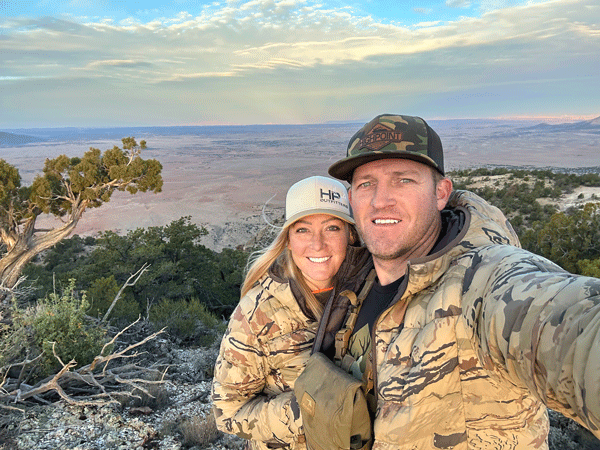
I’m very thankful to have shared these experiences with my husband, John Adams of High Point Outfitters. I’m lucky to have the best guide and hunter in my corner. I’m also extremely thankful to have good friends and family who love hunting as much as we do and come on these adventures to help! Thanks Papa John Adams, Kevin Call, and Shane Woodruff—your help was invaluable.