September 2026

Worth the Wait: An Oregon Columbia Blacktail Deer Hunt
Hunter: Robert E. Mays Jr.
Species: Columbia Blacktail Deer
Location: Southwest Oregon
Method: Rifle, guided by Cooper Reese
This adventure actually began way back in 1996, when I joined Huntin’ Fool. I took their advice of “acquiring points now will lead to drawing tags in the future” to heart. I began acquiring preference points in Oregon as well as many other states. I was hoping to obtain a quality mule deer tag at some point in the future. However, over the years, I had taken some great mule deer, and I was more interested in hunting for a good Columbia blacktail deer. I had been following the points needed to draw the quality tags in Oregon as indicated by Huntin’ Fool. I was near the top and decided to start making plans for a hunt.
Drawing Oregon’s Only Non-Resident Tag with 28 Points
In January of 2024, I met John Mccollum of Eden Ridge Outfitters. I indicated that I was looking for a quality opportunity for Columbia blacktail deer. Based on the number of points that I had acquired, John suggested a unit in southwest Oregon, but the one non-resident tag was not available to draw until 2025. I was then introduced to Cooper Reese, my guide for the planned hunt. He was very excited about the opportunity to hunt the unit during the rut.
In January of 2025, I spoke with Cooper, and our plans remained the same. The application period for Oregon arrived, and I applied, hoping my twenty-eight points would be enough to be awarded the tag. On June 12, I was rewarded with success! I contacted Cooper, and we made plans to hunt in late November. He told me that by then, the rut was usually in full swing.
Hunting the Blacktail Rut
A week and a half before I was due to arrive, Cooper contacted me and asked if I could come a week early. A cold front with precipitation was expected, and this just might jump-start the rut. He really thought we should be hunting during this time. This hunt was my priority, so I agreed. I arrived the day prior to our first day of hunting. We checked the rifle, and all was well. Cooper and I discussed the opportunity that this unit and hunting time presented. There were great bucks here, the rut should be starting soon, and the vegetation had lost most of its leaves, making spotting easier. We were looking for that “special buck”.
The first two days, several bucks were spotted. However, none seemed to be in rut mode, and none were that “special deer”. Day three, things changed. The bucks were moving more during the day. We spotted a tall-framed buck right at dark, different than anything we’d seen so far. However, we couldn’t see what he was in the fading light. Cooper told me that he had "the look.”
Day four was the same; bucks were moving, but there was nothing that we wanted to pursue. What became evident was that we were not getting a second look at any of the larger bucks we had spotted. The vegetation, even with the leaves gone, was thick, and the drainages were long and steep, limiting the amount of country that could be seen. Cooper was hoping that we could find a good buck earlier in the day so that we would have the opportunity to get on him, make a shot, and recover him in the light. This is where the rut was going to help.
A Rutting Buck at 1,100 Yards
Day five started like all the rest; however, there was minimal fog that day, so Cooper decided to go higher into the mountains earlier. We went to a drainage that we had glassed a couple of times before. A good four-point ran some does on the far side, and they went out of sight around the ridgeline. Cooper wanted to get a better look at him. We moved to the other side of the knob to get a closer look. I found the does but was unable to find the buck, so I approached Cooper. He stated that he had found the buck we wanted, and it was not the one that I was trying to find.
He was rutting a doe way down in the bottom of the drainage eleven hundred yards away. I quickly set up my scope and found him. He carried dark, heavy, deeply forked four-point antlers with an extra tine on the back left. He was moving with the doe, and it was very evident that he was going where she was going. We didn’t want to lose sight of them, so we decided to wait and see where they would bed down.
After about a half hour, the couple bedded down. Cooper and I had discussed our options. We agreed that our best opportunity would be going around the backside of the ridge, dropping down the drainage, and finding a closer spot to shoot from. We made our move to get within shooting distance, and we found an old logging road that made our travel much faster. Fortunately, the deer had bedded in a relatively open area with good landmarks. The doe was clearly visible, but the buck was in the brush from our angle. We searched for a spot to set up for the shot.
A Small Window for the Shot
Since the deer had bedded toward the bottom, we encountered a lot of brush blocking our view. Cooper found a small window to shoot through, and I cleared some branches that were in the way. We set up, and I waited for him to stand. I didn’t have to wait long. When comfortable, I touched off the shot. It looked like a solid hit; however, a second shot was needed to make sure he wasn’t going anywhere.
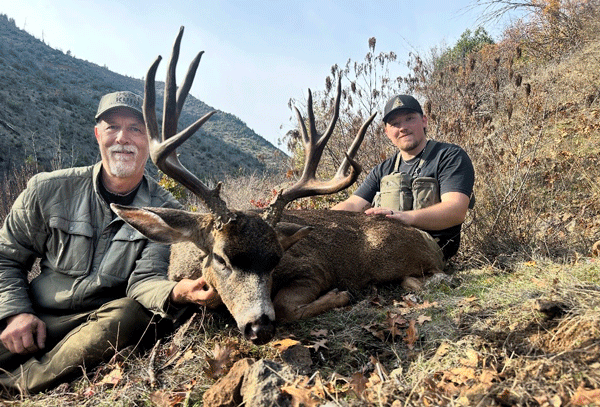
We worked our way to the buck, and he was all that I had dreamed about. Heavy, deeply forked, dark horns with some extra character. He was worth the wait!
A special thank you to Cooper Reese for his hunting and spotting expertise as well as his knowledge of blacktail deer and the hunting area.

Additional Resources
- Oregon Application Strategy
- Oregon State Profile
- Oregon Hunting Regulations
- Huntin' Fool Adventures
- Become a Huntin' Fool Member