January 2026
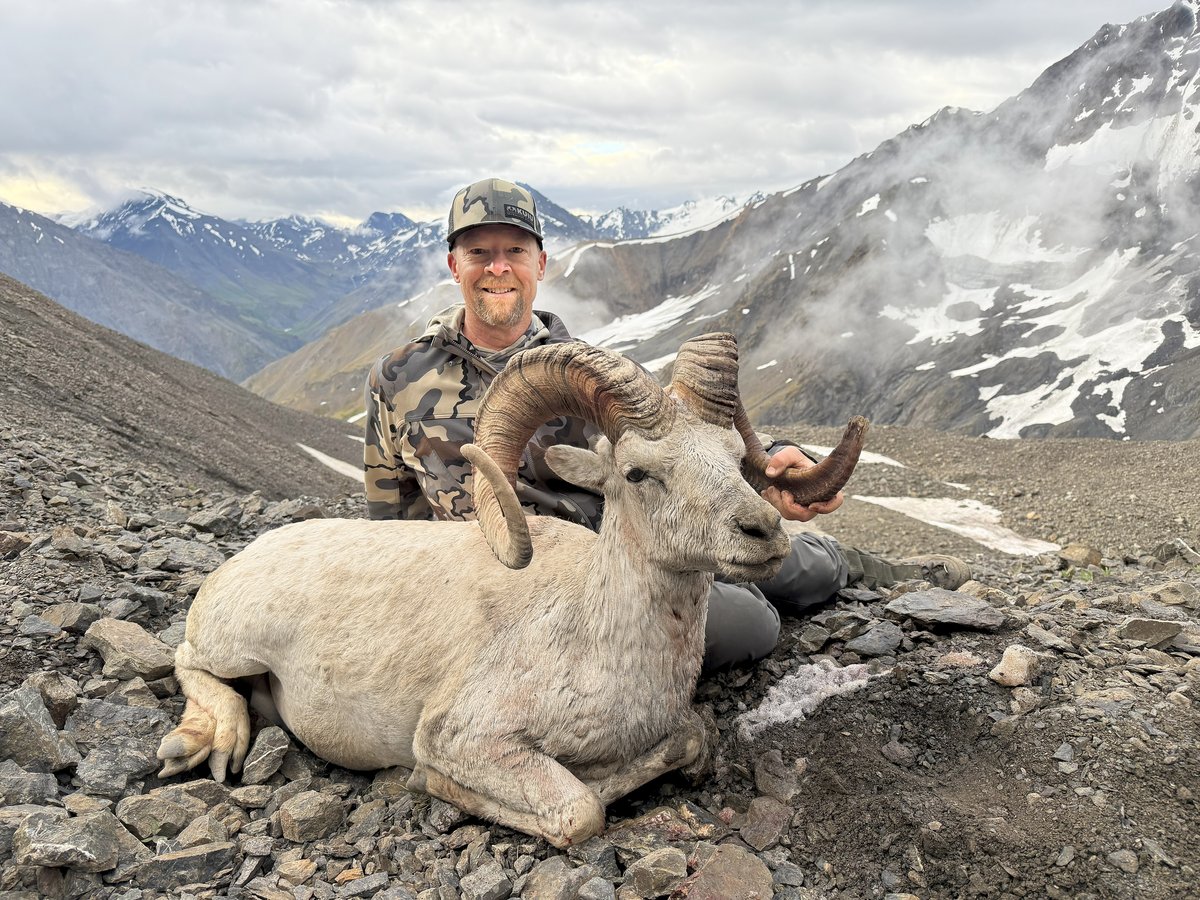
Dall Sheep Hunting | Alaska
Story By: Mike Wilcynski
My first encounter with a bighorn sheep was along the Tucannon River in southeast Washington. I was fifteen at the time. A few rocks started tumbling down from the basalt outcroppings above as I was fishing the stream below. Several rams emerged, feeding and stirring up the hillside. My fly rod hit the deck instantly, and I made tracks up the steep slope for a closer look. After closing the gap, I became completely captivated by their stunning beauty, majestic nature, and presence. I was hooked. The thought of hunting sheep has consumed me ever since.
Fast forward thirty-seven years, tons of research, countless applications, and who knows how many raffle tickets later, I received a call from Dan Montgomery on February 21 that would change everything. “Mike, are you feeling lucky today? You just got drawn for sheep in Alaska. Congratulations.” Game time—my name was officially on a sheep tag.
Staying fit through weight training, running, mountain biking, hiking, and Nordic skiing has always been an integral part of my life. However, it was time to dial things up a notch to prepare for the hunt and make sure physical fitness would not be the limiting factor. My wife and daughters became familiar with the phrase “sheep shape.” I recited the words daily, and they joined me on several hikes with a heavy pack filled with golf balls, water, and anything else I could find to reach sixty to seventy pounds. We are fortunate to have an extensive trail network right outside the front door of our home in Montana.
Dan called on July 16 with great news—he had found a couple of good rams in the permit area. The permit required a ram at least eight years old or of full curl, so hearing that we had options was encouraging. Honestly, I did not need much motivation, but knowing there were promising rams around certainly built my confidence ahead of the hunt. Dan’s timing was impeccable.
On August 5, Rick met me at the Anchorage airport. We loaded the gear and headed toward an airstrip along the Knik River, anticipating that we might be flown in that afternoon if the weather cooperated. Moments after we parked the truck, I signed a few documents, and we got the call that Dan would be picking us up in five minutes. We scrambled, loaded my pack, changed clothes, shot my rifle, and hopped in the plane. The quick turnaround got my heart rate up a bit, and my mind was racing, hoping I had everything necessary for the next few weeks. Rick and Lauren did an outstanding job ensuring I was good to go.
Nolan and Evan, the two guides accompanying me on behalf of Dan, were already in the backcountry waiting at the remote landing strip. After quick introductions, Dan was back in the air. We sorted through our gear and loaded our packs a third time before beginning the hike up the drainage to what would become our base camp. The scenery was breathtaking—steep, rugged, massive, and everything I had dreamed of. The Chugach Range is one of a kind, just as Dan had described. We were in for an epic adventure.
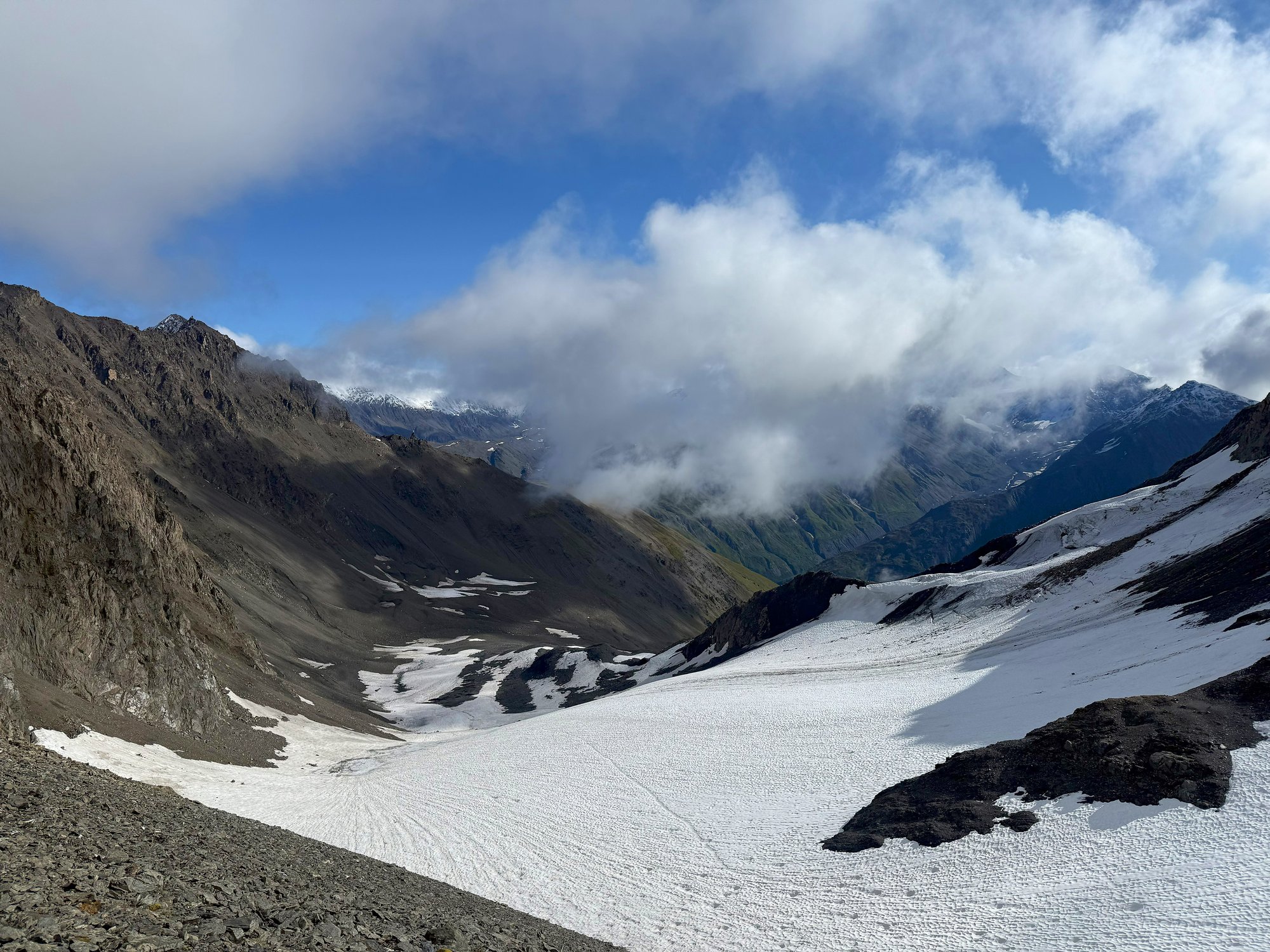
The season opener was August 10, and we were in the field five days early to scout and locate a ram. We took advantage of the clear skies on day two and hiked up a side drainage and over into the next basin. When Nolan pointed out our route the prior evening, I thought he was nuts. The terrain looked nearly vertical leading up to the saddle we needed to cross, and upon closer inspection, it essentially was. We climbed seven hundred feet in less than nine-tenths of a mile. As we stepped into the saddle, I was treated to one of the most spectacular views I had ever seen. After soaking it in for a few minutes, we dropped off the top, down a glacier, over the next ridge, and into a pocket of rocks and grassy benches. Moments later, Evan said the magical word, “Sheep!”
We pulled out the spotting scopes and studied the ram before he disappeared around the ridge. Once he was completely out of sight, we dropped down to the next bench, quickly gained a new vantage point, and discovered six rams. We studied them for a couple of hours and determined one was full curl and nine years old. Two others were close to full curl but too far away to age accurately without risking bumping the legal ram. Nolan made the call to back out and return to base camp, leaving the rams undisturbed for the next few days.
Days three and four were spent at base camp. Rain kept us close to the tents, with short hikes to explore the surrounding country and a little rest ahead of opening day. Having a couple of rams spotted was a blessing, and we decided to take full advantage of the downtime and conserve energy for later in the hunt.
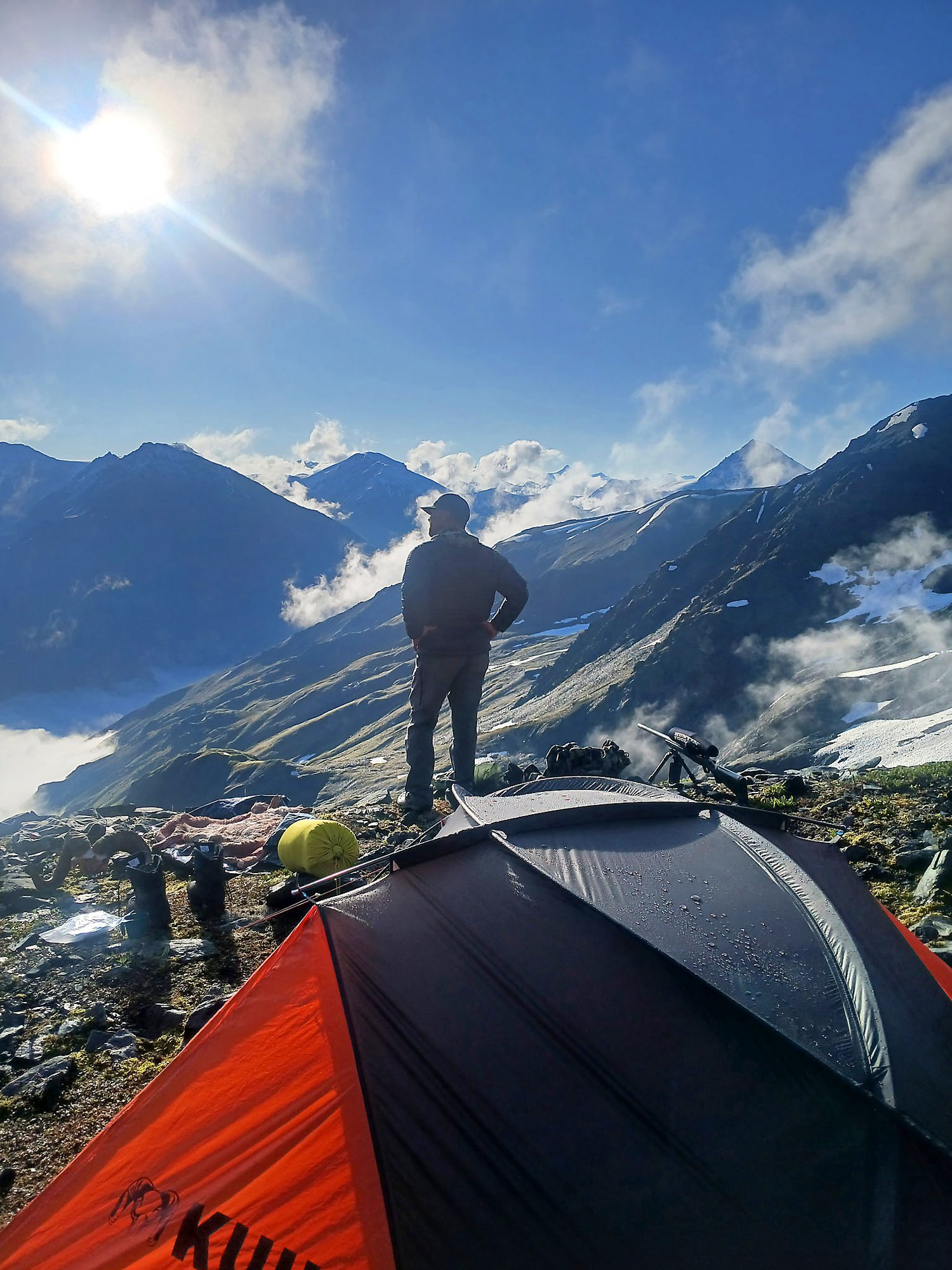
On day five, Nolan decided we would pack enough gear for three days and head into the next basin to set a spike camp below the glacier, within an hour’s hike of the rams we had spotted earlier. After settling in, we managed to spot a few mountain goats between bursts of rain and fog, and later in the evening we glassed up sheep—better yet, rams. One of our target rams joined two others and crested the ridge above camp. My mind went into overdrive. Was this real? Were we in trouble? I watched as the rams worked closer. Nolan and Evan were calm and not worried at all. By nightfall, the rams bedded within a thousand yards of camp. Nolan’s last words before we turned in were, “Mike, if you need to get up and pee or step out of the tent at all, stay low and out of sight. They’re bedded just above us.” My response: “We only have one hour and twenty-seven minutes until the opener. I can’t wait to see which comes first—a pee break, a stretch, or setting up the rifle for a shot.”
Dark skies won out, and the rams faded from view as we managed a couple of hours of restless sleep before waking to fog on opening morning. Certainly not ideal conditions. We took turns poking our heads out of the tent, hoping to spot the rams. Around 6:00 a.m., I made out two of the bedded rams. We gathered our gear, confirmed the full-curl ram was still with the group, and discussed a plan to get within range. There was no cover between us and the rams, so we waited for the fog to roll back in and hustled across the scree field. Unfortunately, the fog lifted mid-route, leaving us exposed in the open about seven hundred yards below them.
The ram began feeding our way while we crawled into a boulder field to set up for a shot. I settled in behind the rifle, Nolan confirmed he was legal, and Evan set up the phone on a tripod to record. We were ready, but the ram was not. When he finally turned broadside, Nolan gave the signal, and I applied pressure to the trigger. The ram staggered, stayed on his feet for a moment, and then tipped over, tumbling several hundred feet down the mountain. Unbelievable—6:24 a.m. on opening morning, and we had a beautiful ram on the ground. We did it.
Over the next few hours, we took photos, broke down the ram, and returned to spike camp. It was hard to leave such a beautiful place, so we decided to stay one more night. At 6:30 the next morning, Nolan broke the silence with his now-infamous phrase to Evan: “What’s the best part about waking up?”—the cue for him to boil water for coffee. I was glad we stayed. The morning was absolutely stunning, a view that words can barely describe.
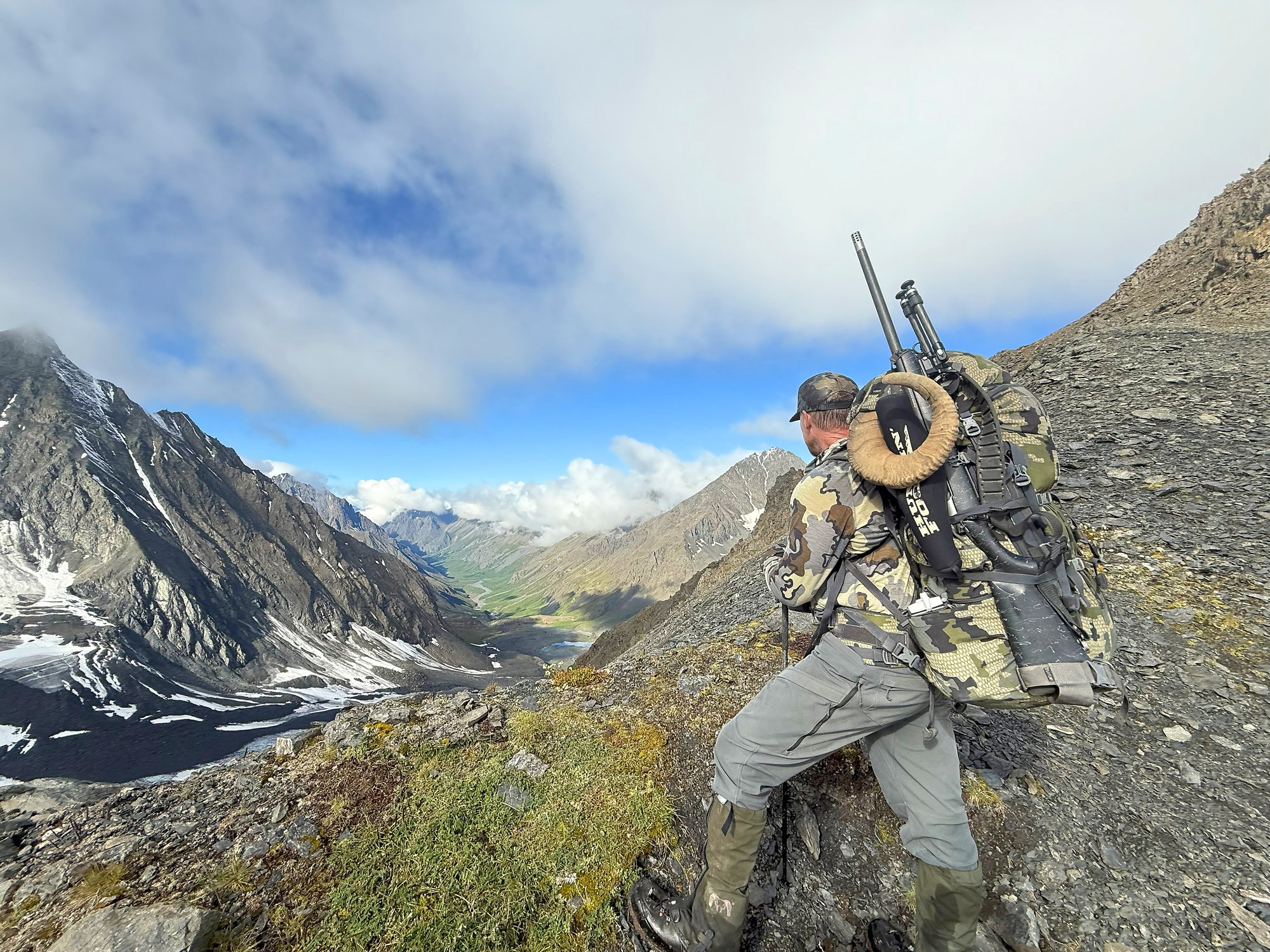
After more photos and a moment to take in the beauty of it all, we began the seven-and-a-half-mile pack out to the airstrip. I am sure the packs were heavy, but it hardly mattered; I am not even sure my feet touched the ground.
My first sheep hunt was absolutely incredible and everything I had dreamed of. I am grateful for the support of my family, Dan (a true legend), and the crew at Alaska Trophy Adventures. Dan has assembled a team of dedicated sheep hunting fanatics who work tirelessly to deliver results: Nolan (27 years), Evan (5 years), and Rick (18 years). This was my first fully outfitted hunt, and Alaska Trophy Adventures set the bar high. Thank you.