What A Couple of Turkeys
Oklahoma remains an accessible turkey destination because the regular spring and fall seasons are over the counter and the spring season is statewide. The required annual hunting license and turkey license total $249, and hunting a Wildlife Management Area adds a $100 Nonresident Game Bird Permit. Certain leased southeastern properties and Oklahoma Land Access Program tracts instead require a $200 nonresident Land Access Permit.
The controlled-hunt program is a separate bonus opportunity for limited-access properties. It uses a weighted random draw rather than a true preference draw. In the 2025-26 spring turkey draw, ODWC offered 101 adult permits against 13,342 choice-level applications, 1 in 132.1. Youth odds were materially better: 25 permits against 1,294 choice-level applications, or 1 in 51.8.
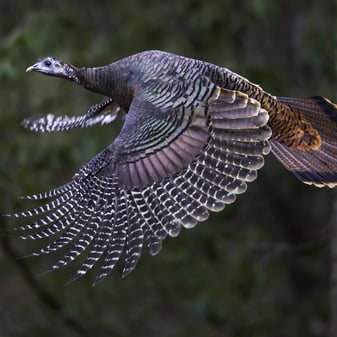
For 2026, biologists reported more birds than the prior year across much of Oklahoma, with western drought holding some areas closer to stable. Rio Grande turkeys dominate central and western Oklahoma; Easterns occupy the east and southeast; Merriam's influence is limited to the far western Panhandle, with hybridization in transition zones.
Oklahoma's controlled-hunt application is completed through a Go Outdoors Oklahoma account. The most recent window ran April 1-May 20, 2026. As of this update, ODWC had not published the 2027 application deadline, so applicants should use the 2026 dates only as a planning reference and verify the next window when ODWC opens the new cycle.
A nonresident must possess a valid Oklahoma hunting license before applying. ODWC specifically accepts the annual, fiscal-year, or 5-day nonresident hunting license for draw eligibility. The adult 5-day license is not valid for regular season turkey hunting. For application fee, ODWC's specific cost schedule lists $50 for nonresidents and $10 for residents, paid once per year.
Spring turkey applicants may make up to three standard choices. Extra choices beyond the program wide standard allowance cost $3 each, with no stated cap, but the same hunt cannot be selected twice.
An unsuccessful applicant earns one point. Each point functions as an additional entry in future drawings. Points improve odds but never guarantee selection. Zero point hunters can still draw.
A nonresident may buy an additional preference point for $50. PointGuard also costs $50 per category and protects points if a selected hunter cannot attend under program rules.
ODWC conducts drawings in June and notifies successful applicants by email. Status and hunt documents are available in the Go Outdoors Oklahoma account/app. A controlled-hunt turkey does not count against the regular-season limit.
No drawing is required for the statewide regular spring season, statewide fall archery season, or fall gun season in open counties. Buy the required base license and season specific turkey license through Go Outdoors Oklahoma.
Youth hunters age 17 and younger receive a two day statewide spring season before the regular opener. Nonresident youth use either the $76 5 day Super Hunting License or $151 annual Super Hunting License. A youth turkey during the youth weekend counts toward the regular spring limit.
Advisor Articles from Our Magazine on Application and Hunting Strategy
ODWC does not publish a separate nonresident allocation or residency specific odds for controlled spring turkey hunts. The published rules place eligible residents and nonresidents in the same weighted random hunt pools. Accordingly, the ratios below are overall choice level ratios, not individual applicant odds and not nonresident only odds. Personal odds improve with points and by entering multiple distinct choices.
| 2026 Adult Hunt | Code | Dates | Apps | Permits | Draw Ratio |
|---|---|---|---|---|---|
| Little River NWR | 6040 | Apr. 24-26 | 1,113 | 20 | 1 in 55.65 |
| McAlester AAP | 6051 | Apr. 17-19 | 1,276 | 14 | 1 in 91.14 |
| McAlester AAP | 6050 | Apr. 10-12 | 1,470 | 14 | 1 in 105.00 |
| McCurtain County WA | 6060 | Apr. 10-12 | 1,707 | 16 | 1 in 106.69 |
| Four Canyon Preserve | 6021 | Apr. 10-11 | 244 | 2 | 1 in 122.00 |
| Cross Timbers WMA | 6001 | May 9-13 | 1,266 | 10 | 1 in 126.60 |
| Four Canyon Preserve | 6020 | Apr. 3-4 | 358 | 2 | 1 in 179.00 |
| Deep Fork NWR | 6010 | Apr. 20-May 16 | 2,019 | 10 | 1 in 201.90 |
| Cross Timbers WMA | 6000 | Apr. 16-20 | 2,219 | 10 | 1 in 221.90 |
| Tishomingo NWR | 6080 | Apr. 23-24 | 1,670 | 3 | 1 in 556.67 |
Year over year pressure increased. Adult choice level applications rose from 12,715 for 113 permits in 2024 (1 in 112.5 overall) to 13,342 for 101 permits in 2026 (1 in 132.1). That is a 4.9% increase in recorded choices paired with a 10.6% permit reduction, producing approximately 17% worse odds.
Youth controlled hunts are their own draw category and remain Oklahoma's best limited entry value. The 2025-26 results were:
| 2026 Youth Hunt | Code | Dates | Apps | Permits | Draw Ratio |
|---|---|---|---|---|---|
| Deep Fork NWR | 7020 | Apr. 11-May 16 | 259 | 10 | 1 in 25.90 |
| Little River NWR | 7040 | Apr. 17-19 | 157 | 5 | 1 in 31.40 |
| Hugo CoE (Kiamichi Park) | 7000 | Apr. 4-5 | 277 | 4 | 1 in 69.25 |
| Salt Plains NWR | 7075 | Apr. 10-19 | 141 | 2 | 1 in 70.50 |
| Wichita Mtns. NWR, walk-in | 7096 | Apr. 10-12 | 204 | 2 | 1 in 102.00 |
| Washita NWR | 7010 | Apr. 10-12 | 256 | 2 | 1 in 128.00 |
Oklahoma does not offer a fall turkey controlled hunt category, so there are no fall permit totals, draw odds, preference point requirements, or nonresident draw statistics to analyze. Fall opportunity is OTC. Archery is statewide; the gun season excludes Atoka, Choctaw, Coal, Delaware, Latimer, Le Flore, Mayes, McCurtain, Ottawa, Pittsburg, Pushmataha, Rogers, and Tulsa counties. Both seasons are male only, and the combined fall limit is one male regardless of method.
ODWC's 2024 game harvest survey estimated 12,449 fall hunters, 2,490 turkeys, and roughly 20% harvest per hunter. Ninety five percent of participating fall turkey hunters reported using only private land, underscoring that public land fall opportunity is a minor portion of the hunt.
| Priority | Hunt | Why It Stands Out |
|---|---|---|
| Best adult odds | Little River NWR 6040 | 1 in 55.65; 20 permits, the largest adult allotment. |
| Second adult choice | McAlester AAP 6051 | 1 in 91.14; later of two AAP weekends drew less pressure. |
| Low-demand | Four Canyon 6021 | Only 244 applications, but just two permits kept odds at 1 in 122. |
| Best youth odds | Deep Fork NWR 7020 | 1 in 25.90 with a long hunt window and 10 permits. |
| Youth value | Little River NWR 7040 | 1 in 31.40; five permits and the second-best youth ratio. |
| Season | Season Dates | Area | Requirements and Restrictions |
|---|---|---|---|
| Regular Spring | April 16-May 16, 2027 | Statewide | Archery or shotgun only. Rifles and handguns are prohibited. |
| Youth Spring | April 10-11 2027 | Statewide | Hunters must be 17 or younger and accompanied by a qualified adult. |
| Fall Archery | October 1, 2026-January 15, 2027 | Statewide | Archery equipment only |
| Fall Gun | October 31-November 20, 2026 | Open Counties | Shotgun only under turkey regulations |
| Public WMAs and GMAs | Area-Specific dates | Areas where turkey hunting is listed as open | Nonresidents need the $100 Game Bird Permit. Hunters must use ODWC’s check-in and check-out system on designated areas. |
| OLAP walk-in lands | Varies by enrolled tract | Participating OLAP properties | Access depends on posted tract rules. All nonresidents need the $200 Land Access Permit. |
| Honobia Creek and Three Rivers WMAs | Area-specific dates | Leased southeast Oklahoma WMAs | These areas offer extensive acreage. Nonresidents need the $200 Land Access Permit. |
| Herron Family WMA | Area-specific dates | Herron Family WMA | Resident-only |
$199 BILLED ANNUALLY
Everything in Pro, plus unlimited one-on-one hunt consultations, and everything you need to prep like a pro and hunt like a fool.
$48 BILLED ANNUALLY
Access community intel, research tools, and our online magazine. Draw more tags and go on more hunts with better information.
| Subspecies | Primary Distribution | Notes |
|---|---|---|
| Rio Grande | Central, western, and much of northern Oklahoma | Most widespread opportunity; riparian roosts, prairie edges, wheat, cattle country, and mixed oak-grass habitat. |
| Eastern | Far east and southeast, especially wooded mountain country | Lower, less stable densities than western birds; large timber-company tracts reward walking and terrain study. |
| Merriam's | Far western Cimarron County/Panhandle | Localized and frequently described as hybrid influence rather than a broad, pure Merriam's range. |
ODWC publishes two different kinds of turkey numbers: mandatory E-Check counts and survey based estimates. The survey estimates include modeled participation and harvest, while E-Check is the number reported through the mandatory system.
| Data Series | Year | Spring | Fall | Participation / Success |
|---|---|---|---|---|
| ODWC harvest survey estimate | 2023 | 9,122 | 1,622 | Spring: 33,286 hunters; 27% harvest |
| ODWC harvest survey estimate | 2024 | 9,733 | 2,490 | Spring: 40,961 hunters; 24% harvest |
| Mandatory E-Check | 2023 | 5,601 | Not Reported | Direct check count; one-tom rules in effect |
| Mandatory E-Check | 2024 | 6,245 | 382 | Spring +11.5% from 2023 |
The comparable survey series increased 7% for spring and 54% for fall from 2023 to 2024. Mandatory spring check-ins also rose in both 2024 and 2025 after the 2022 reduction to a one-tom limit. ODWC's 2026 field report described higher population numbers in most regions, but the west remained drought-sensitive.
During the spring regular season, one tom statewide, regardless of method. A youth season bird counts against this limit. During the fall regular season, one tom statewide, regardless of whether taken by archery or gun. A controlled hunt counts as a bonus bird and does not count against the corresponding regular season limit. A hunter could legally take one regular spring tom, one regular fall tom, and an additional controlled hunt tom if drawn and otherwise compliant.
| Item | Fee | When Required / Important Detail |
|---|---|---|
| Annual Hunting License, adult | $209 | Required base license for adult OTC turkey; valid 365 days. |
| 5-Day Hunting License, adult | $75 | Eligible for controlled-hunt application, but not valid for regular turkey hunting. |
| Youth Annual Super Hunting | $151 | Base and turkey privileges for nonresidents age 17 and younger; valid 365 days. |
| Youth 5-Day Super Hunting | $76 | Short-term youth option valid for turkey. |
| Spring or Fall Turkey License | $40 | Adult additional license; each season license is listed separately by season. |
| Nonresident Game Bird Permit | $100 | Required when hunting game birds on a WMA, GMA, PHA, WRP, WDU, or WMU. |
| Land Access Permit | $200 | Required for all nonresidents using OLAP and specified leased properties. |
| Controlled-hunt application | $50 | Nonresident annual draw fee; specific ODWC controlled-hunt cost schedule. |
| Extra draw choice | $3 | Each additional choice beyond the standard allowance. |
| Extra preference point | $50 | Optional nonresident point purchase in a category. |
| PointGuard | $50 | Optional nonresident insurance per category. |
| Drawn turkey permit | $50 | Nonresident permit fee for a successful controlled-hunt applicant. |
| Bonus Turkey License | $20 | Required for a nonresident controlled-hunt turkey. |
| Federal area user fee | $20 or $40 | $20 Deep Fork/Little River NWR; $40 McAlester AAP. |
Anyone age 30 or younger who is not certified must hunt on an apprentice designated license unless exempt. For turkey, the qualified accompanying hunter must be at least 18, licensed unless exempt, hunter education certified unless exempt, and within sight and normal voice communication. Hunters age 31 or older, active duty or honorably discharged U.S. Armed Forces members, and National Guard members are exempt from certification. A youth hunter must be accompanied by an adult age 18 or older with a current hunting license. The adult may not hunt or possess archery equipment or firearms during the youth turkey hunt. Immediately attach a field tag with the hunter's name, customer ID, date, and time. E-Check the turkey within 24 hours of leaving the hunt area and before processing; retain the confirmation number with the carcass.
| Season | Season Dates | Area | Requirements and Restrictions |
|---|---|---|---|
| Regular Spring | April 16-May 16, 2027 | Statewide | Archery or shotgun only. Rifles and handguns are prohibited. |
| Youth Spring | April 10-11 2027 | Statewide | Hunters must be 17 or younger and accompanied by a qualified adult. |
| Fall Archery | October 1, 2026-January 15, 2027 | Statewide | Archery equipment only |
| Fall Gun | October 31-November 20, 2026 | Open Counties | Shotgun only under turkey regulations |
Legal shooting hours are one-half hour before official sunrise to official sunset. Always check area specific regulations; WMAs can close seasons, shorten hours, impose combined area limits, or restrict methods beyond statewide rules.
Northwest: Canton, Sandhills, Fort Supply, and Cooper WMAs. This is classic Rio Grande country with riparian roosts, prairie, wheat, and cattle ground. Bird numbers were stable to higher across much of the region, but Panhandle numbers were only stable. Drought limited green up. Midday can be productive after gobblers leave hens.
Southwest: Black Kettle, Packsaddle, and Sandy Sanders WMAs. Expect open Rio habitat, cottonwood drainages, red-dirt breaks, and wheat. Drought makes current water, green forage, and recent burns more important than a generic county ranking.
Central and north-central: Kaw WMA combines agriculture and roost habitat near the Kansas line; Deep Fork WMA offers remote river bottoms and uplands within reach of both major metro areas; Hickory Creek is a south central alternative. Pressure is highest near easy access, so focus on walk-in river bends, secondary parking points, and weekdays.
Northeast: Cherokee PHA. Eastern and Rio influence overlap in this region, and habitat includes oak-hickory woodland, pasture, creek bottoms, and agriculture. Area specific rules vary substantially, so confirm that spring turkey is open before building a trip.
Southeast: Honobia Creek and Three Rivers provide roughly 260,000 acres of timber company country and are the state's scale play for Eastern turkeys. Both require the $200 nonresident Land Access Permit. The terrain is steep, heavily forested, and access can be weather dependent. Use recent burn units, benches, logging roads, and mature hardwood drainages to narrow the acreage. Herron Family WMA is not open to nonresidents.
Oklahoma added mandatory check-in/check-out for nonresidents on designated public areas in 2025. The process is free, but it is separate from the Game Bird Permit or Land Access Permit. Cell service can be unreliable, so complete the required digital steps at the last reliable connection and retain confirmation according to ODWC instructions.
Buy the right license. The $75 adult 5 day license can qualify a nonresident to apply for controlled hunts, but it cannot be used for the regular turkey season. An OTC adult turkey trip requires the $209 annual hunting license plus the $40 turkey license.
Treat Little River as the adult odds anchor. Its 20 permits produced the best 2025-26 adult ratio at 1 in 55.65.
Do not chase a nonexistent point threshold. Oklahoma's turkey draw is weighted randomly. More points mean more entries, but no point total guarantees a permit and first time applicants can draw.
Use all meaningful choices. Three standard spring turkey choices are available, and extra choices cost $3. Every distinct hunt entered creates another path to a permit; repeating a hunt is not allowed.
Youth applicants should prioritize Deep Fork and Little River. Their 2025-26 ratios of 1 in 25.90 and 1 in 31.40 were far better than any adult hunt.
Price public access before choosing a region. An adult WMA trip is generally $349 (209 + $40 + $100). OLAP or leased southeast access can raise the licensing/access total to $449 (209 + $40 + $200).
Check the exact property, not just the statewide season. Controlled hunts, closures, combined limits, access permits, and method restrictions can change at the area level.
Avoid opening weekend pressure. ODWC's 2026 report repeatedly notes busy public lands. Weekdays and late morning periods after hens leave gobblers can improve hunt quality.
Carry a writable field tag, your customer ID, and a backup method for recording the time. Complete E-Check within 24 hours of leaving the hunt area.
At Huntin' Fool, we are always looking for ways to improve our service and help out members to the very best of our abilities. We believe communication is what makes our Huntin' Fool community great!