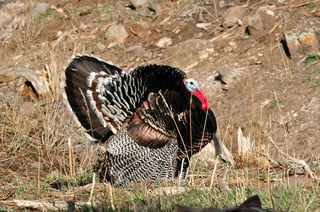
What A Couple of Turkeys
In 1980, when I used to live in Missouri, on a visit to one of my friends in St. James, Missouri two...

| UP-FRONT FEES | |
| Base Hunting & Conservation Licenses | $25.00 |
| Sheep, Moose, Goat, and Bison Application Fee | $50.00 |
| Bonus Points (Optional/Per Species) | $20.00 |
| Preference Point Only (For Combo Licenses) | $100.00 |
| Outfitter Preference Point Only (For Combo Licenses) | $100.00 |
| Big Game Combination License (Elk & Deer)* | $1,315.50 |
| Elk Combination License* | $1,115.50 |
| Deer Combination License* | $781.50 |
| Youth Big Game Combination License* | $671.50 |
| Youth Elk Combination License* | $571.50 |
| Youth Deer Combination License* | $404.50 |
| Antelope (Includes the $5 Application Fee) | $205.00 |
| Special Elk Permit Application | $9.00 |
| Special Deer Permit Application | $5.00 |
| Bow and Arrow License (Mandatory for All Archery Hunts) | $10.00 |
| *All Combination License prices include required Base Hunting License, Conservation License, Aquatic Invasive Species Prevention Pass, and Application Fees | |
| POST DRAW FEES (IF SUCCESSFUL) | |
| Bighorn Sheep License | $1,250.00 |
| Moose License | $1,250.00 |
| Mountain Goat License | $1,250.00 |
| Bison License | $1,250.00 |
| Wolf License | $50.00 |
| Wolf License (If You Draw a Combination License) | $25.00 |
| UP-FRONT FEES | |
| Base Hunting & Conservation Licenses | $18.00 |
| Sheep, Moose, Goat, and Bison Application Fee | $10.00 |
| Bonus Points (Sheep, Moose, Mountain Goat) | $75.00 |
| Bonus Points (Elk, Deer, Antelope) | $25.00 |
| General Deer License | $16.00 |
| Deer B License | $10.00 |
| Youth General Deer License | $8.00 |
| General Elk License | $20.00 |
| Elk B License | $20.00 |
| Youth General Elk License | $10.00 |
| Antelope (Includes the $5 Application Fee) | $19.00 |
| Bow and Arrow License (Mandatory for All Archery Hunts) | $10.00 |
| POST DRAW FEES (IF SUCCESSFUL) | |
| Bighorn Sheep License | $125.00 |
| Moose License | $125.00 |
| Mountain Goat License | $125.00 |
| Bison License | $125.00 |
| Wolf License | $10.00 |
| MONTANA ELK SEASON DATES | |
| Archery | Sept 5 – Oct 18, 2026 |
| Rifle | Oct 24 – Nov 29, 2026 |
| Backcountry (HDs 150, 280, 316) | Sept 15 – Nov 29, 2026 |
| MONTANA DEER SEASON DATES | |
| Archery | Sept 5 – Oct 18, 2026 |
| Rifle | Oct 24 – Nov 29, 2026 |
| Backcountry (HDs 150, 280, 316) | Sept 15 – Nov 29, 2026 |
| Youth Hunt | Oct 15 – 16, 2026 |
| MONTANA ANTELOPE SEASON DATES | |
| Archery | Sept 5 – Oct 9, 2026 |
| Archery (900) | Aug 15 - Nov 8, 2026 |
| Rifle | Oct 10 – Nov 8, 2026 |
| MONTANA BISON SEASON DATES | |
| Any Weapon | Nov 15, 2026 - Feb 2027 (varies by unit) |
| MONTANA MOOSE SEASON DATES | |
| Archery | Sept 5 - 14, 2026 |
| General | Sept 15 - Nov 29, 2026 |
| MONTANA BIGHORN SHEEP SEASON DATES | |
| Archery | Sept 5 - 14, 2026 (varies by unit) |
| Any Weapon | Sept 15 - Nov 29, 2026 (varies by unit) |
| MONTANA MOUNTAIN GOAT SEASON DATES | |
| Archery | Sept 5 - Sept 14, 2026 (varies by unit) |
| Any Weapon | Sept 15 - Nov 29, 2026 (varies by unit) |
| MONTANA BLACK BEAR SEASON DATES | |
| Spring | Apr 15 – June 15, 2026 |
| Fall Archery | Sept 5 - 14, 2026 |
| Fall | Sept 15 – Nov 20, 2026 |
Disclaimer: Dates vary by hunting district (HD) and may change through emergency regulations. Always confirm with Montana FWP before planning your hunt: : https://fwp.mt.gov/hunt
| YEAR | ELK & DEER | MOOSE, MTN GOAT, SHEEP & BISON | ANTELOPE 900-20 & B LICENSES | RIFLE ANTELOPE / SUPER TAGS |
|---|---|---|---|---|
| 2026 | April 15, 5:50 p.m. | May 8 @ 11:10am | June 12 | Early August |
| 2025 | April 15, 3:05 p.m. | May 7, 2:20 p.m. | June 13 | August 6 |
| 2024 | April 15, 3:38 p.m. | May 8, 3:00 p.m. | June 17 | Early August |
| 2023 | April 17, 3:08 p.m. | May 12, 3:50 p.m. | June 14 | Aug 8 |
| 2022 | April 14, 1:14 p.m. | May 10, 10:00 a.m. | June 13 | - |
| 2021 | April 14, 11:00 a.m. | May 11, 9:44 a.m. | June 18 | - |
| 2020 | April 14, 4:00 p.m. | May 11, 9:45 a.m. | June 15 | August 6 |
| ANNUAL | Mid-July (Super Tags) |
Montana is one of the West's most flexible turkey states for nonresidents. Turkey licenses are sold over the counter, there is no application deadline or point system, and hunters can combine a statewide general license with regional and area-specific licenses when the authorizations do not overlap. Merriam's turkeys dominate much of the state, while Eastern birds and hybrids occur primarily in portions of eastern Montana. The principal constraint is access: many of the state's strongest flocks use private agricultural ground, wooded river corridors, and private-public edges.
Take the stress out of application season and hunt with confidence.
Huntin’ Fool’s Application Service handles every detail for you—building the best strategy, maximizing your draw odds, and making sure you never miss a deadline.
We apply. You hunt.
Montana does not conduct a turkey permit draw. There is no turkey application deadline, draw-result date, preference or bonus point system, or resident/nonresident allocation.
General, regional, and area-specific turkey licenses are purchased through Montana FWP's online licensing system or a license provider. A nonresident must first hold the required Conservation License and Base Hunting License. Licenses remain subject to the sex, season, region, county, and boundary printed in the regulations. An OTC sale does not make every turkey license valid statewide. Youth use the same OTC framework, and Montana does not assign a separate nonresident turkey quota.
Advisor Articles from Our Magazine on Montana Application and Hunting Strategy
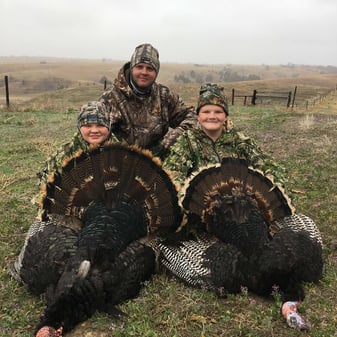
Spring licenses are unlimited OTC, so there are no draw odds or point requirements. The 2025 survey estimated a spring harvest of 7,612 birds: 4,987 on general licenses and 2,625 on regional licenses. Nonresidents accounted for an estimated 2,759 spring birds, or 36.2% of the spring total, from approximately 3,034 nonresident spring hunters. License totals should not be read as unique hunters because one person may hold more than one authorization.
Fall opportunity is also OTC and has no nonresident allocation or draw odds. The 2025 survey estimated 2,411 fall birds: 1,666 on general licenses and 745 on regional licenses. Nonresidents harvested an estimated 288 fall birds, or 12.0% of the fall total, with approximately 569 nonresident fall hunters participating. Fall validity is more geographically and biologically specific than the statewide spring general license, so hunters should select a region only after confirming the current boundary and sex authorization.
| License type | Quota | 2025 issued | 2025 annual harvest |
|---|---|---|---|
| General | Unlimited OTC | 36,851 | 6,653 |
| Regional | Unlimited OTC | 10,662 | 3,369 |
| All licenses | Unlimited OTC | 47,513 | 10,023 |
Montana does not conduct a turkey permit draw. There is no turkey application deadline, draw-result date, preference or bonus point system, or resident/nonresident allocation.
Montana's license framework can allow one hunter to hold as many as 16 turkey licenses in a license year. The practical OTC route includes the statewide general license, one regional license in each of Regions 1, 2, 5, and 7, and limited-area female/beardless or either-sex licenses in designated counties or portions of Regions 1, 4, and 7. Region 5's regional license is spring-only. Because local authorizations can change, use the current regulation map and license description rather than relying on a county name alone.

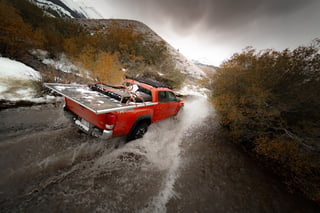
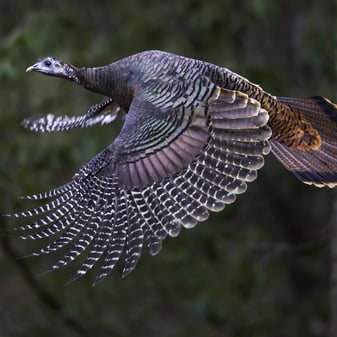
Merriam's and Eastern wild turkeys are Montana's principal subspecies, with hybrid birds where populations overlap. Merriam's opportunity is strongest in ponderosa pine breaks, open conifer foothills, and southeastern badlands. Easterns are associated more closely with deciduous river bottoms, shelterbelts, and agricultural mosaics in eastern Montana. Western valleys can support localized Merriam's or mixed flocks where winter range, roost trees, and private feeding areas occur together.
The 2025 survey estimated 10,023 turkeys harvested statewide (80% confidence interval: 9,860-10,186), up 5.4% from 9,513 in 2024. Spring harvest increased 16.2% to 7,612 and represented 75.9% of annual harvest, while fall harvest declined 18.5% to 2,411. License issuance increased 3.9%, from 45,717 general and regional licenses in 2024 to 47,513 in 2025. Nonresidents held 5,339 licenses, 11.2% of the total, but accounted for an estimated 3,047 birds, or 30.4% of statewide harvest.
The state's hunter-success measure is based only on license holders who hunted. It reports 64.47% success for nonresident hunters, 43.28% for residents, and 48.77% statewide. This differs from management success, which divides estimated harvest by all licenses issued; nonresident management success was 57.1%. Harvest estimates below are rounded to the nearest bird, while percentage changes use the unrounded estimates.
| Harvest category | 2024 | 2025 estimate | Change |
|---|---|---|---|
| Spring general | 4,417 | 4,987 | +12.9% |
| Spring regional | 2,136 | 2,625 | +22.9% |
| Spring total | 6,553 | 7,612 | +16.2% |
| Fall general | 2,050 | 1,666 | -18.7% |
| Fall regional | 910 | 745 | -18.2% |
| Fall total | 2,960 | 2,411 | -18.5% |
| Annual total | 9,513 | 10,023 | +5.4% |
A hunter may hold up to 16 turkey licenses during the license year, but each license authorizes one bird and carries its own season, sex, and geographic limits. The maximum can include one general license; one regional license in each of Regions 1, 2, 5, and 7; multiple female/beardless licenses in specified portions of Region 1 and in Missoula, Ravalli, and Mineral counties; one limited fall either-sex license in portions of Fergus and Petroleum counties in Region 4; and one Region 7 fall either-sex license. A hunter cannot treat the 16 license ceiling as a statewide bag limit. Read every license description before hunting.
A nonresident needs a Conservation License, a Base Hunting License, and the applicable turkey license. A Season Upland Game Bird License is optional, but it reduces each nonresident turkey license from $115 to $57.50. At the listed rates, the upland option first becomes cheaper at two turkey licenses: $250 versus $255. Hunters born after January 1, 1985, must provide recognized hunter-education certification unless hunting under an authorized apprentice exception. Youth must meet Montana's age, education, and supervision rules; there is no separate youth-only turkey draw.
| Item | Fee | Notes |
|---|---|---|
| Base Hunting License | $15 | Required |
| Conservation License | $10 | Required |
| Turkey License | $115 | OR $57.50 with Season Upland Game Bird License |
| Season Upland Game Bird License | $110 | Optional; lowers each turkey-license price |
| Youth Upland Game Bird License (ages 12-17) | $55 | Youth eligibility rules apply |
| Season | Dates | Legal Wildlife/ Authorization |
|---|---|---|
| Spring | April 15-May 31, 2026 | Male turkey; general and qualifying regional licenses |
| Fall | September 1, 2026-January 1, 2027 | Either-sex or female/beardless only where the license authorizes it |
Legal shooting hours are one-half hour before sunrise to one-half hour after sunset. Spring hunting is limited to legal archery equipment and shotguns; consult the current regulations for ammunition and equipment specifications. Fall weapon rules and each license's boundary must also be confirmed before hunting. Southeastern Montana remains the best starting point for a destination hunt, especially ponderosa pine breaks, wooded draws, and the Yellowstone River corridor from Sidney west toward Big Timber. Other established pockets occur near Kalispell; along the lower Clark Fork from Noxon to Thompson Falls; along the Missouri River; and southeast of Roundup and Lewistown. Public-land options include portions of Custer Gallatin National Forest, BLM ground, state trust lands, and enrolled Block Management Areas, but the birds often move between public roost cover and private feeding areas.
Scout access before buying multiple licenses. Use FWP's Hunt Planner to verify ownership and regional boundaries, then check each parcel's access conditions. In spring, the final two weeks of April through early May usually provide the best balance of vocal birds and manageable pressure, while later May can reward hunters who locate higher-elevation or less accessible flocks. Fall hunters should focus on flock concentrations in riparian cover, grain fields, and sheltered wintering habitat, with permission secured before the season.
Montana turkey licenses are OTC, and no preference or bonus points are involved.
Buy only one turkey license without the upland license; at two turkey licenses, the Season Upland Game Bird License saves $5 at the listed fees, and the savings increase with each additional tag.
Treat regional and county licenses as separate authorizations. Confirm season, sex, and boundary language before purchasing or crossing a region line.
Start access work early in southeastern Montana. Private river bottoms and agricultural edges can hold more birds than nearby public parcels.
Use Block Management Areas and state/Federal ownership layers to build a public-access route, then verify seasonal road closures and parcel-specific rules.
At Huntin' Fool, we are always looking for ways to improve our service and help out members to the very best of our abilities. We believe communication is what makes our Huntin' Fool community great!